

Deal intake for a cross-border advisory firm
A systems-thinking artifact modeling how governed capital firms structure inbound opportunities before the first conversation.
The Context
Cross-border advisory firms operate complex mandates — but intake is still informal.
Cross-border advisory and capital firms operate complex mandates across jurisdictions, counterparties, and regulatory environments. But despite the sophistication of execution, intake is still largely informal.
Inbound arrives via generic contact forms, email introductions, and partner inboxes. This creates friction long before real work begins.
The Problem
Capital firms do not have an intake problem. They have a legibility problem.
Most firms treat intake as a marketing surface — not an operating system. Senior partners spend first conversations triaging context instead of exercising judgment. As mandate volume, regulation, and cross-border complexity increase, this intake model does not scale.
Core Insight
Intake is not a form. It is an operating decision.
The quality of downstream outcomes — partner time, governance, execution speed — is determined by what is captured before the first conversation. Before CRM. Before data rooms. Before mandates are accepted.
Transformation
Industry pain → System solution
Pain Point
All inbound looks the same, regardless of seriousness or readiness
Status Quo
Serious family offices, operators, and counterparties all submit through identical contact paths. No context exists before the first call. Partners spend first conversations triaging instead of exercising judgment.
Structured Entry Lanes
Role-based entry lanes differentiate between Family Offices & Principals, Operating Companies, and Trading Counterparties. Each lane captures mandate-specific context so conversations start at the right altitude.
Pain Point
No qualification before partner time
Status Quo
Deal size, timing, and seriousness are discovered live, wasting senior attention. Exploratory ideas and deal-ready mandates arrive indistinguishably.
Guided Mandate Intake
A guided 4-step intake captures ticket size bands, transaction intent, timing horizon, and documentation readiness. Only sufficiently shaped profiles advance to structured review.
Pain Point
Jurisdictional complexity is discovered late
Status Quo
Multi-country realities surface after momentum has built, triggering governance friction. Where the business operates, where the transaction sits, and where capital flows are discovered mid-process.
Jurisdiction Footprint Capture
The spine records jurisdiction footprint at entry — UAE, UK, India, GCC, Europe, North America, and beyond. Routing and governance expectations are set immediately.
Pain Point
Cross-office execution is implicit and fragile
Status Quo
Offices are listed as locations, not functional owners. Who leads, who analyses, who coordinates — responsibility is inferred, not assigned.
Explicit Routing Logic
Explicit routing logic makes visible how mandates coordinate across relationship leadership, deal analysis & structuring, and documentation & coordination. Geography becomes an operating model, not a footer.
Pain Point
Status lives in email tone and response lag
Status Quo
Clients and teams infer progress from inbox behavior. 'Have you had a chance to look at this?' becomes the most-asked question.
Shared Status Ladder
A shared status ladder — Draft → Submitted → Clarification → Ready for review → Under review → Governance checkpoint → Decision issued → Next steps agreed — provides one language, one spine, legible to all parties.
Pain Point
Governance is stated in policy, not embedded in flow
Status Quo
AML, KYC, and risk standards exist in policy documents — not in daily flow. Compliance is appended to process rather than embedded in it.
Visible Governance Gates
Governance gates are embedded as discrete steps in the intake and review path, with clear ownership and light audit trace. Compliance happens during review, not after momentum has built.
Pain Point
Readiness is opaque
Status Quo
Exploratory ideas and deal-ready mandates arrive indistinguishably. No signal indicates whether teasers exist, financials are available, or approvals are in place.
Readiness Indicators
Readiness indicators capture documentation status at entry. The system uses this signal — combined with urgency and complexity — to route each mandate to the appropriate review pathway.
Pain Point
Leadership time is spent on routing, not judgment
Status Quo
Senior leaders act as inbox routers and context builders. First meetings are consumed by basic triage instead of assessment, direction, and decision-making.
Upstream Filtering
Upstream filtering absorbs sorting and qualification so leadership time is reserved for fit, direction, and decision-making.
What's Included
Features built into this prototype
Every component solves a specific intake and governance problem — not surface aesthetics.
Intervention Logic
The system responds differently depending on who is entering — and how ready they are.
Rather than treating every enquiry identically, the prototype computes three signals — urgency, readiness, and complexity — and uses them to determine a specific outcome. Not a score. An operating response.
Fast-track Review
High urgency, high readiness. The mandate is shaped and time-sensitive. Route directly to senior review.
Structured Review
Clear intent, moderate complexity. The mandate needs structured assessment before partner time is committed.
Clarification Required
Signal is present but incomplete. Specific gaps are identified and surfaced — not a generic 'we'll be in touch.'
Pre-mandate Conversation
Early-stage intent. The opportunity is real but not yet shaped. The system acknowledges this honestly.
Respectful Decline
Misaligned on scope, jurisdiction, or scale. The system communicates this with clarity and professionalism.
This is a leverage point. By changing what partners see — and when — the system reshapes downstream decisions without adding headcount, software, or process overhead. The firm's expertise is signaled through how it qualifies, not how it markets.
Intentional Restraint
Not a CRM
Not a deal room
Not a portfolio system
This is the front door — the part most firms neglect and where leverage is highest.
See it in action
Explore how structured intake, routing logic, and governance placement change the tone of inbound — before a single email is sent.
Related prototypes

Booking site for a medical spa
Treatments, results and a five-step booking for a luxury aesthetics practice.
View case study
Marketing site for a SaaS startup
A product site the marketing team can update without engineering.
View case study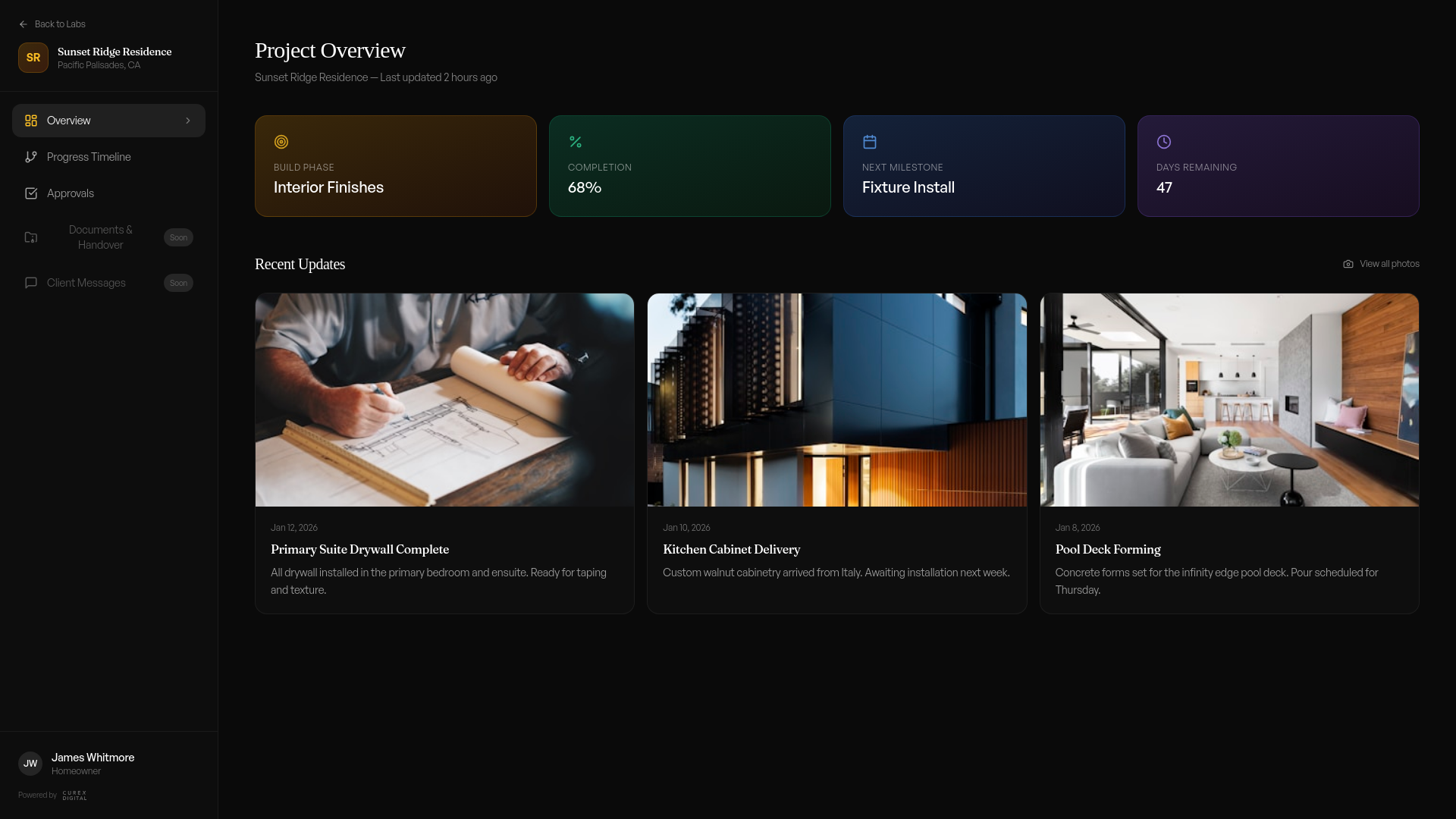
Client Portal for Builders
One portal for progress, client communication and handover.
View case study